



20 Feb The night time economy: What is missing from the debate
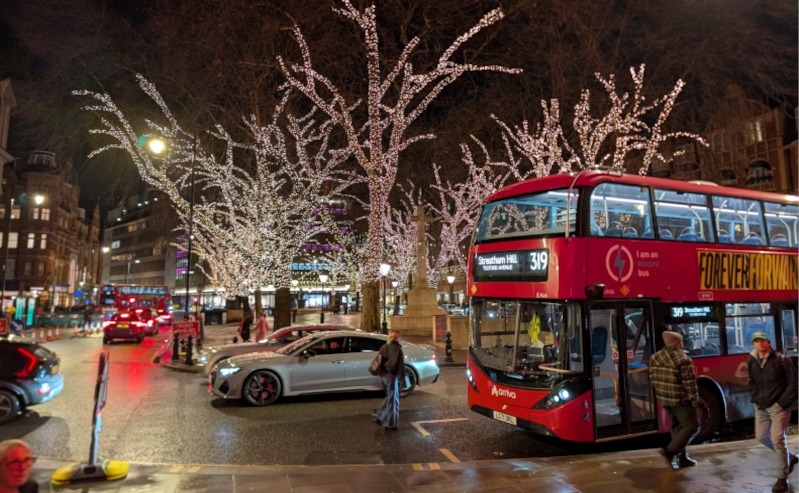
[Image: Sloane Square, London with lights in trees year-round]
The night time economy is back on the government’s radar, but there is something missing from the current debate, writes The Assembly Line’s Diane Cunningham.
Many of our high street projects include an element of night time activity, whether it’s looking at how existing activities can be extended later, how businesses can be supported to open in the evening and/or facilities available for those working at night.
The importance of night time activities to places
Evening and night time activities are important for towns and city centres. They prevent the hard stop where the retail businesses/services close and places empty out, which was so common in smaller towns in the past.
Where activities and businesses are closely matched to what people want from their evening, they provide new reasons to visit, create employment and can improve safety with more people around.
In 2019, I was involved in a pilot project for the Mayor of London supporting night time activities and extended opening hours in Walthamstow, East London. During the pilot, footfall increased by 22%, attracted more families and young people, and there were improved perceptions of safety.
The success of the pilot led to more night time enterprise zones being set up since. It also demonstrated that evening activities don’t have to centre on alcohol. It showed that the night time economy doesn’t just have to be about bars and clubs.
The Night Time Economy Summit (NTES) I attended earlier this month provided a picture of the challenges and trends [link to article], and there was an important government presence at the event.
More government intervention
In her keynote, Labour MP Angela Rayner called on the government to have a dedicated Minister for Night Time to champion the sector.
New licensing plans by London Mayor Sadiq Khan were announced to support and grow the capital’s nightlife industry.
The summit also touched on the opportunities for combined authorities to have more control over licensing. Focus from politicians is undoubtedly a positive, but amid the summit and more general chat about the sector, there are some omissions.
What is missing from the debate on the night time economy
High street renewal and the night time economy are often referenced together but treated as separate entities. It would be good to see a more holistic approach.
Yes, people who understand the nuances of the night time economy are vital but the night time economy doesn’t operate in isolation.
The talk around the night time economy often centres on pubs and clubs, but that is only part of the story. At NTES there was mention of extending services into the evening, such as comedy clubs widening their offer, but there is so much more happening at night.
There are a whole range of reasons for people to be out at night, including work, visiting the gym, participating in games activities eg. chess clubs or for education.
There may well be a myriad of community-based activities going on in religious buildings, community halls, libraries and back rooms in pubs, from youth clubs to choirs and social clubs. These can form an important part of the footfall generated in the evening.
So what should we be doing?
A start would be to make the night time economy an integral part of high street-focused conferences and events, and vice versa so they aren’t viewed in isolation.
It’s important to map the night time economy in a place and include everything that is already happening, not just the number of pubs, clubs, and arts venues like theatres, which are all a vital part of the mix, of course.
Even in places perceived as being quiet in the evening, the results will likely surprise you.
From this, you can start considering which activities could be extended from day into evening or run later. What support is needed – people, businesses, transport – to ensure this would be successful?
Who is working at venues where these activities are taking place, what will their journey options be, are they safe/affordable, and are they running at the times they need them?
Is there an opportunity to create more jobs, with better facilities for those working at night, if aspects of the night time economy are unblocked?
It’s important to recognise the importance of the night time sector in offering entry level jobs (and career progression) to young people, building their confidence and providing them with skills which can equip them for the future.
Can meanwhile (temporary) uses create spaces in which to test evening activities?
The night time economy, like the daytime economy, is an ecosystem linked to transport, venues and F&B alongside planning and regulations, and all need to work together to maximise success. The problem is that in many places we work, this simply isn’t the case.
Angela Rayner’s speech and the work of the London Nighttime Taskforce, highlights the need for night time to be recognised as part of the UK’s culture. It is often promoted and positioned in a way that it is important, but this isn’t reflected in how it is treated from policy to taxation.
Over 2m people* work in the night time economy, excluding taxi drivers and those who work night shifts. This presents an opportunity to grow the sector to create more employment and businesses.
Only a more holistic approach, treating the night time economy as part of a bigger picture, will create places that thrive and give those operating at night a better chance of success.
(* Annual Night Time Economy Report)
If you need help in understanding what’s happening at night or bringing businesses together, get in touch.
This is our February newsletter where we discuss things we have seen and lessons learnt monthly.
Sign up to The Assembly Line newsletter for urban and place shaping observations.