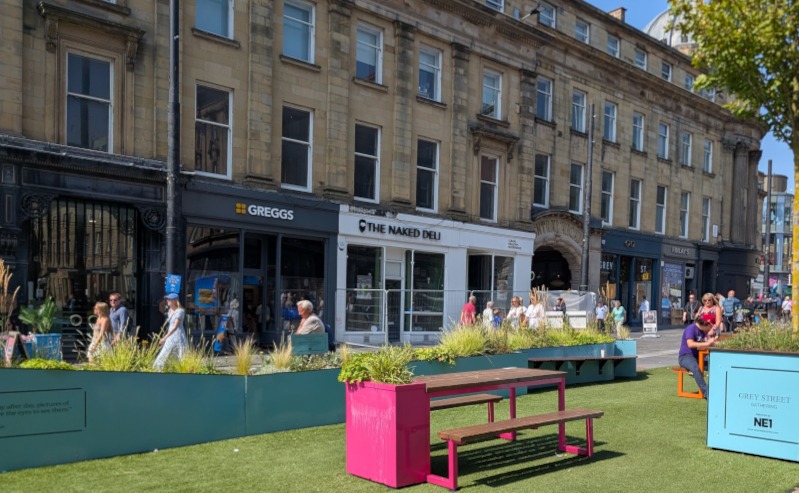
What do the night-time economy, the seaside and landlocked town centres have in common?
Visiting a raft of events focused on different types of place economies has shown The Assembly Line founder, Diane Cunningham, that there are common challenges running through placemaking and place shaping. And that the different economic threads are mutually dependent.
The NTE is having a really hard time at the moment. Understandably the impact of the cost-of-living crisis was at the forefront of conversations at the NTE summit but there are also changing consumer patterns.
From experience, the focus for smaller towns and villages is on activating the 5-9pm time slot, in bigger places the challenge is often transport and safety-related themes.
This is something that also came up at the ATCM conference.
Town centre living and activity
Without residents or visitors, a 4pm hard stop is common as shops close early. Out-of-town jobs compound the problem, with few reasons to visit the centre.
While in Hull for the conference, the streets of the city centre were eerily quiet on a weekday evening.
As we heard at the NTE Summit, affordability is an issue everywhere, but in a smaller city where a lot of jobs and the university are located outside the centre, the lack of footfall was very visible.
However, we heard about (and saw the results) from the many events which attract people into the centre. It was a lesson that if you put on something interesting, people will come. The crucial question is how that is replicated throughout the year.
But the city is doing many things right, from linking up different parts to plans to repurpose one of the shopping centres. It is hoped these changes will encourage people back into the centre to live, visit and socialise.
The balance is important. History shows that simply adding flats to town and city centres doesn’t solve the problem. Homes have to work with night time uses and also cater for a mixed population, not just one demographic.
There are places trying to do this, for example, Manchester is adding retirement living and facilities for young families to the city centre.
Young people and education
Educational facilities can help with the challenge of attracting young people to a place, but retention is dependent on there being suitable jobs in the area once they graduate.
A college or university campus not only brings footfall, but can also create connections with a town or city. Lincoln has a university campus in its city centre and is an example of how this drives activity in contrast to Hull, where, as already touched on, the university is outside the centre.
The University of Lincoln could be contributing to longer opening hours, while in Hull, many places don’t open Monday to Wednesday.
Celebrating heritage and the visitor economy
Heritage can also play a role in connecting people to a place. It can bring a sense of individuality rather than relying on nostalgia.
Hull’s focus on its maritime heritage is an example of how the past can be used to shape the place brand and its future.
Regeneration projects in the city aim to extend day visits to overnight stays, which then support the night time economy and jobs.
There are many different reasons for people to visit a town or city centre, not just during the day, but also at night (read more on the night time economy here).
A key lesson for placemaking and place shaping is to look for the links between the different uses and users.
Lessons everywhere: The importance of place visits
Seeing how different places function, where they work and don’t, can be hugely beneficial for delivering thriving places.
London is often the exception rather than the norm. There are things London does brilliantly, that won’t work elsewhere.
Sometimes you don’t need to go far for a different perspective. Liverpool, Manchester and Leeds, for example, are all quite different. Similarly, the London boroughs are hugely varied.
There are also some good things happening in small places that might work well in a London neighbourhood. A toy and book library, for example, can work in a village or on a London high street.
For me, getting out and seeing places is about professional development/learning. It allows me to bring plenty of examples to conversations and gives me a huge network to call on for information.
This is our March newsletter where we discuss things we have seen and lessons learnt monthly.
Sign up to The Assembly Line newsletter for urban and place shaping observations.
This website uses cookies to improve your experience. We'll assume you're ok with this, but you can opt-out if you wish. Cookie settingsACCEPT
Privacy & Cookies Policy
Privacy Overview
This website uses cookies to improve your experience while you navigate through the website. Out of these cookies, the cookies that are categorized as necessary are stored on your browser as they are essential for the working of basic functionalities of the website. We also use third-party cookies that help us analyze and understand how you use this website. These cookies will be stored in your browser only with your consent. You also have the option to opt-out of these cookies. But opting out of some of these cookies may have an effect on your browsing experience.
Necessary cookies are absolutely essential for the website to function properly. This category only includes cookies that ensures basic functionalities and security features of the website. These cookies do not store any personal information.
Any cookies that may not be particularly necessary for the website to function and is used specifically to collect user personal data via analytics, ads, other embedded contents are termed as non-necessary cookies. It is mandatory to procure user consent prior to running these cookies on your website.